

$2.5MResearch grants as principal investigator
$7.3MResearch grants held jointly
$2.2MScience education & outreach grants
60Trainees (undergrads, grads, postdocs)
45Refereed publications
2Scholarships established for students
Research
What we work on
Three programmes, each with the key terms reviewers and applicants search for. Those same terms drive the application form, so prospective students can match their training against ours before they write to us.
Optical diagnostics
A point-of-need vitamin D test built on aptamers, a fibre-optic Raman probe that reads liver fat content in about a second under ordinary room light, and EGFR-targeted nanoprobes for cancer imaging.
Molecular holography
The first demonstration anywhere of CW stimulated SERS. Next: hundreds of distinct particles tracked in three dimensions, label-free.
Equitable participation in STEMM
Who actually works in Canadian physics, and what keeps others out. Canadian Physics Counts is the first national survey of its kind.
Training outcomes
What people do after this lab
Over 60 trainees have passed through the lab — undergraduate, graduate students and post-docs. They leave able to design and align an optical bench, not just run the software that came with it.
Dr Onur Bulut
Postdoctoral fellow · Newest member of the lab
A biochemist working across molecular biology, biochemistry and nanomaterials. Developing an aptamer-based biosensor for vitamin D — the lab’s newest diagnostics programme.
Benjamin Hansson
Masters, 2025
Now a PhD student at Saint Mary’s University in the lab of Danielle Tokarz.
Hao Guo
PhD student, 2024 · William Leiper Memorial Scholarship
Lead author on four papers in three years, including the Transplantation study on liver discard rates. Built the ambient-light-compatible steatosis probe now heading toward clinical validation. Now a Medical Physics resident at the Icahn School of Medicine at Mount Sinai in New York.
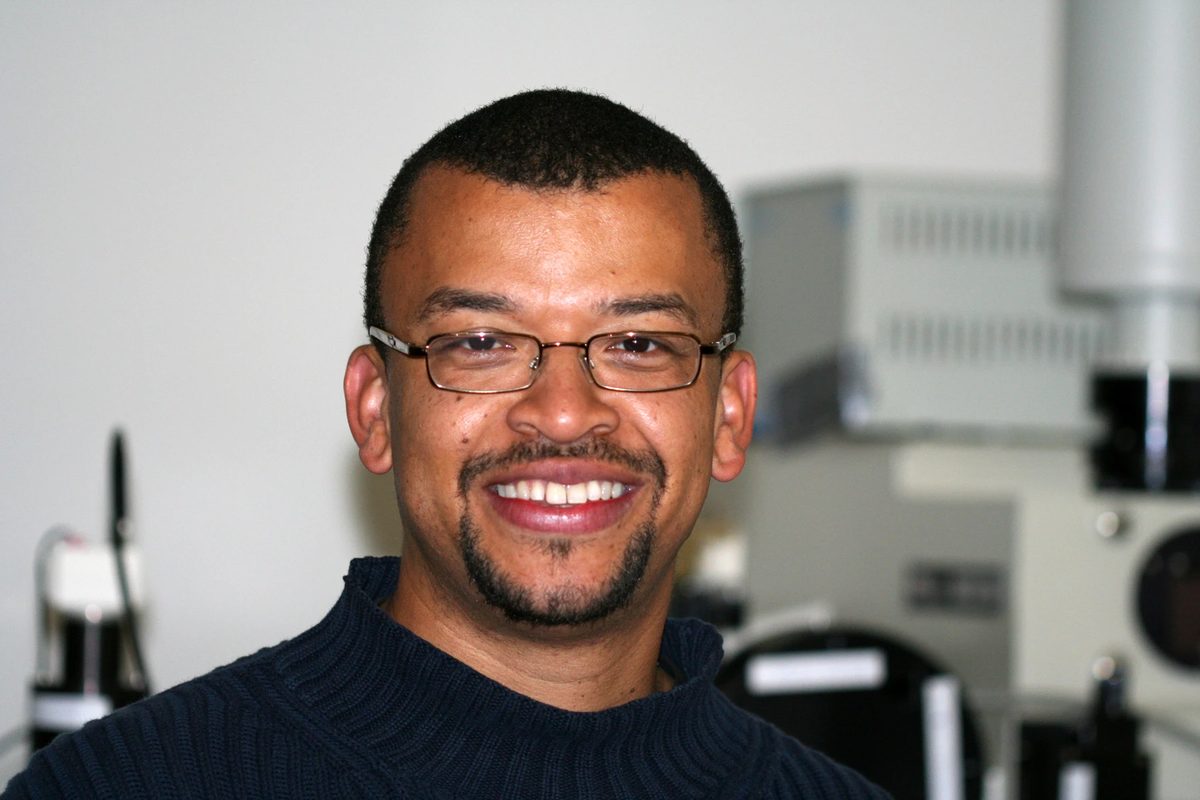
Dr Yashar E. Monfared
Postdoctoral fellow, 2019
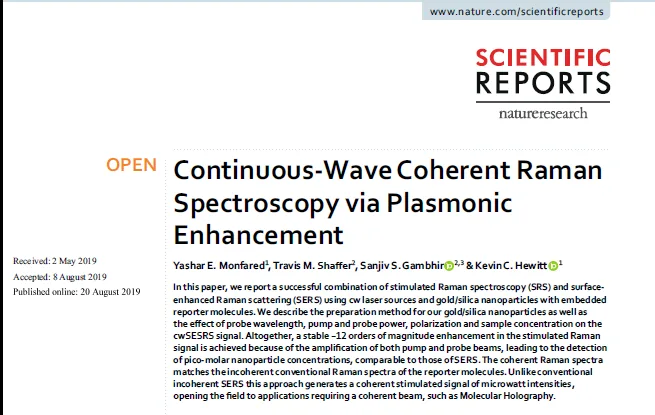
First author on the Scientific Reports paper demonstrating continuous-wave coherent Raman spectroscopy via plasmonic enhancement. Now a Research Consultant and Training Specialist at ACENET Canada.
Facilities
Instruments you would build, not just operate
Most instruments in this lab were designed and built here. Students learn to specify, align and troubleshoot an optical system — the skill that transfers to every job afterwards.
785 nm, lock-in amplification, reads tissue fat in about a second under room light.
Pump–probe bench for CW and pulsed sources, built by a graduate student.
CW laser, beam-splitting optics and CMOS detection for nanoparticle holograms.
Electron microscopy, XRD and mass spectrometry through Dalhousie.
Recent work
Latest publications
- 2025
E. J. Hennessey, A. Smolina, S. Hennessey, A. Tassone, A. Jay, S. Ghose and K. C. Hewitt. “Canadian Physics Counts: An Exploration of the Diverse Identities of Physics Students and Professionals in Canada.” FACETS, vol. 10, pp. 1–16.
- 2025
H. Guo, B. Gala Lopez, I. P. Alwayn and K. C. Hewitt. “Liver discard rate due to conservative estimations of steatosis: an inference-based approach.” Transplantation, vol. 109, no. 10, pp. e609–e618.
- 2024
H. Guo, A. Stueck, J. Doppenberg, Y. Chae, A. Tikhomirov, H. Zeng, M. Engelse, B. Gala-Lopez, A. Mahadevan-Jansen, I. P. Alwayn, A. Locke and K. C. Hewitt. “Evaluation of minimum-to-severe global and macrovesicular steatosis in human liver specimens: a portable ambient light-compatible spectroscopic probe.” J. Biophotonics, vol. 17, no. 12, p. e202400292.
Join us
We are recruiting from anywhere in the world
Graduate students, research assistants and postdoctoral fellows. Some positions are tied to specific grants with a defined profile; the general call for graduate students is open year-round and reviewed on an ongoing basis.